Saturday, April 12, 2008

just wait a second...

An article of faith is that the undecidability of the halting problem makes it impossible to restrict to terminating programs and still have a general-purpose programming language. On the other hand, another article of faith is that we'd be in big trouble if we allowed non-terminating proofs in mathematics (e.g., "Trust me, I have a proof of the Riemann Hypothesis, just wait a second..."). Why the double standard? Do we shackle ourselves by using a fragment of mathematics that disallows (we hope) non-terminating proofs? Or have we been too hasty to accept non-terminating programs? The latter stance is embraced in total functional programming. But I think the former is also not super crazy. With a more interactive notion of proof, potential non-termination would not be so dangerous.


Z: "I have a proof of the Riemann Hypothesis, can you add it to the Book?"

E: "Of course, but first can you tell me how you handle this tricky case?"

E presents tricky case to Z

Z: "Sure, no problem, this case is easily handled by, um, some math, er, ..."

Z stalls

E waits patiently, but keeps the Book firmly shut


In some sense, terminating proofs are just a time-saving mechanism for referees. It would indeed be a shame if Z wasted all of E's time with this pseudoproof of RH. On the other hand, E could be doing other things at the same time, such as drinking coffee, or running SETI@Home.

Thursday, March 13, 2008

anglo-franco photos

In Nottingham, a statue of Kevin Costner:


In London, my sister's cat Arras:


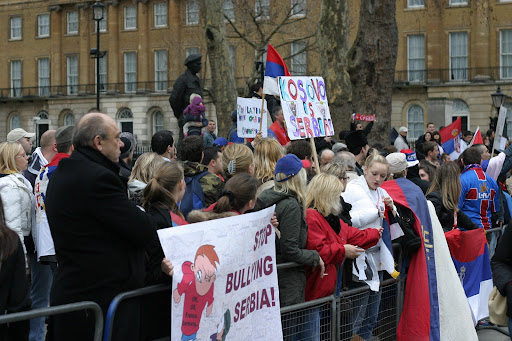
A group of angry Serbian protesters in London:


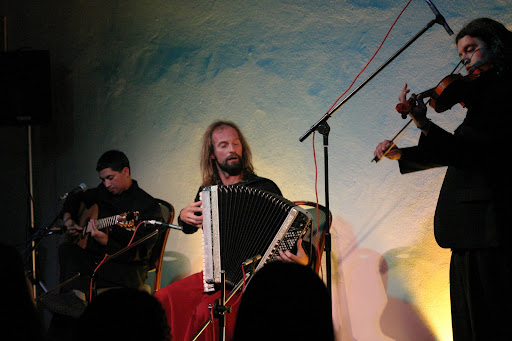
Chango Spasiuk!


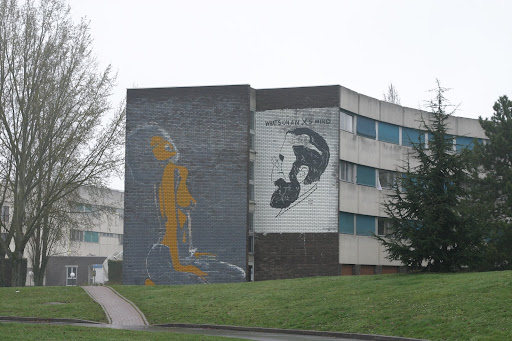
The students at the Ecole Polytechnique in Lozère draw some neat murals:


Paris has a successful bike-sharing program:


The French are serious about their fast food.


The town of Antony, where I stayed with Kaustuv and Vivek, had a delightful Sunday market.


Un canard:


Indian fast food, near the Gare du Nord:


My gracious host Kaustuv:


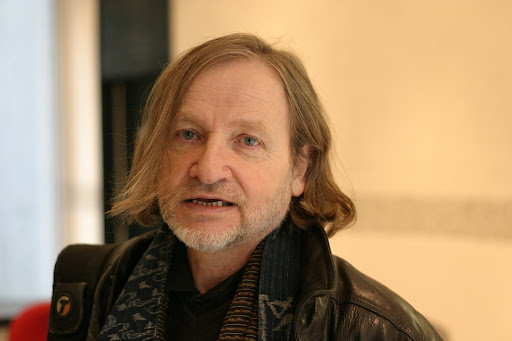
Jean-Yves, after his first lecture on the Geometry of Interaction V:


Neither the subject nor the cameraman were prepared for this photo, hence
Paul-André came out a bit blurry. In real life, he is quite sharp!

Sunday, February 24, 2008

transatlantic updates

So I just arrived in Paris today. Last week I was in Nottingham at DTP, then visiting my sister in London. Both were awesome! In my talk at DTP, I began with some ludics propaganda, then tried to walk the audience through how to encode focusing with higher-order rules in Agda (and extract a functional programming language with explicit evaluation order and pattern-matching). You can check out the annotated agda code. I also had/overheard lots of great conversations, in particular Sebastian Hanowksy taught me some fascinating things about synthetic topology and the delay monad, and Anton Setzer/Peter Hancock piqued my interest in going back to Buchholz's work about the ω/Ω-rule. The highlight of the London visit was probably seeing Chango Spasiuk.

This week I'll be meeting with Paul-André Mellies, and giving talks at PPS and LIX.

Wednesday, January 30, 2008

Fun with polarity and unicode

> Dependent pattern-matching and unicode: a killer combination.
> I will try to post more about this in the next few days.


"Few" is subjective.


Before getting to the Agda code that Dan and I wrote, though, I wanted to talk a little bit about a neat, simple idea I learned recently. In this paper, I argued that one way to rationally reconstruct the linear logic notion of polarity was to turn to so-called proof-theoretic semantics, and in particular Michael Dummett's distinction between verificationist and pragmatist justifications of the logical rules. A verificationist meaning-theory supposes that connectives are defined by their introduction rules, and uses this definition to justify their elimination rules. A pragmatist meaning-theory supposes the opposite: connectives are defined by their elimination rules, and this justifies their introduction rules. Well, polarity lets us refine this picture: the positive connectives are defined by their introduction rules, the negative connectives by their elimination rules.


But another (more fun?) way to think about polarity is through game-theoretic semantics. Think of the truth of a proposition A as a game between Prover and Refuter: A is valid iff Prover has a winning strategy. So the meaning of a connective is essentially a set of rules for playing a game. A few examples:


  • [A ⊕ B] : This is a game where Prover begins by selecting either A or B, after which play proceeds by the rules of that game.

  • [A & B] : This is a game where Refuter begins by selecting either A or B, after which play proceeds by the rules of that game.

  • [A⊥] : Play A, but with the roles of Prover and Refuter swapped.

  • [0] : Prover begins but has no moves, so Refuter automatically wins.

  • [⊤] : Refuter begins but has no moves, so Prover automatically wins.


The polarity of a connective/formula is just the answer to the important question: "Which player begins?" (By the way, this also gives another explanation for focus and inversion. Focus is just the fact that after making a move in the game A ⊕ B, Prover doesn't have to give up her turn to Refuter, e.g., A could itself be the game A₁⊕ A₂. Inversion is the fact that the second player really has no choice in the matter, e.g., in the game A ⊕ B, Refuter has to account for Prover playing either A or B.)


The reason I like this (I think pretty old) idea is that not only is it a good icebreaker at parties, but it also suggests a natural generalization, which Samson Abramsky (a bit tongue-in-cheek) calls Socially Responsive, Environmentally Friendly Logic. Rather than treating only 2-player games between Prover and Refuter, we can encode n-player games using n distinct polarities. For example, Abramsky defines the connective A ⊕α B as the game where α begins play, selecting between A and B. I think this is a really cool and promising generalization.


But anyways, today let's stick with the boring, bipolar world. I'm going to talk about how to give a focused encoding of polarized intuitionistic logic in Agda, which is simultaneously a deep embedding of a language with explicit evaluation order and pattern-matching. For those playing along, the full code is available here. Let's start with some boilerplate:


open import Data.List
open import Data.String renaming (_++_ to concat)

module Main where

Now we define the syntax of polarized formulas, as two mutually inductive datatypes.

module Types where
Atom : Set
Atom = String

mutual
data Pos : Set where
X⁺ : Atom -> Pos
↓ : Neg -> Pos
1⁺ : Pos
_*_ : Pos -> Pos -> Pos
0⁺ : Pos
_+_ : Pos -> Pos -> Pos
2⁺ : Pos
ℕ : Pos

data Neg : Set where
X- : Atom -> Neg
↑ : Pos -> Neg
⊤ : Neg
_→_ : Pos -> Neg -> Neg
_&_ : Neg -> Neg -> Neg

infixr 14 _→_
infixr 15 _&_
infixr 15 _+_
infixr 16 _*_

Positive formulas include positive atoms and shifted negative formulas, as well as strict products and sums. (We would call the units 1 and 0, but unfortunately Agda doesn't let us overload numerical constants.) For fun, we also defined the type of booleans 2⁺, and the type of natural numbers ℕ. Negative formulas include negative atoms and shifted positive formulas, as well as functions and lazy products. Observe the essential use of Unicode!


Now we define hypotheses (positive atoms or arbitrary negative formulas) and conclusions (negative atoms or arbitrary positive formulas), as well as some simple machinery for inspecting contexts. Contexts are basically lists of hypotheses, but since inversion introduces multiple hypotheses at a time, it is more convenient to work with lists of lists of hypotheses. Hence we define LCtx (linear context) and UCtx (unrestricted context), and the membership relationships ∈ and ∈∈. Proofs of membership are isomorphic to De Bruijn indices.


module Contexts where
open Types public

data Hyp : Set where
HP : Atom -> Hyp
HN : Neg -> Hyp

data Conc : Set where
CP : Pos -> Conc
CN : Atom -> Conc

LCtx : Set
LCtx = List Hyp

UCtx : Set
UCtx = List LCtx

data _∈_ : Hyp -> LCtx -> Set where
f0 : {h : Hyp} {Δ : LCtx} -> h ∈ (h :: Δ )
fS : {h h' : Hyp} {Δ : LCtx} -> h' ∈ Δ -> h' ∈ (h :: Δ)

data _∈∈_ : Hyp -> UCtx -> Set where
s0 : {h : Hyp} {Δ : LCtx} {Γ : UCtx} -> h ∈ Δ -> h ∈∈ (Δ :: Γ)
sS : {h : Hyp} {Δ : LCtx} {Γ : UCtx} -> h ∈∈ Γ -> h ∈∈ (Δ :: Γ)

Okay, now we can start the fun stuff. First we define patterns:

module Patterns where
open Contexts public

[_] : {A : Set} -> A -> List A
[_] x = x :: []

-- Pat⁺ Δ A⁺ = linear entailment "Δ ⇒ A⁺"
data Pat⁺ : LCtx -> Pos -> Set where
Px : {x : Atom} -> Pat⁺ [ HP x ] (X⁺ x)
Pu : {A⁻ : Neg} -> Pat⁺ [ HN A⁻ ] (↓ A⁻)
P<> : Pat⁺ [] 1⁺
Ppair : {Δ1 : LCtx} { Δ2 : LCtx } {A : Pos} {B : Pos}
-> Pat⁺ Δ1 A -> Pat⁺ Δ2 B -> Pat⁺ (Δ1 ++ Δ2) (A * B)

Pinl : {Δ : LCtx} {A B : Pos} -> Pat⁺ Δ A -> Pat⁺ Δ (A + B)
Pinr : {Δ : LCtx} {A B : Pos} -> Pat⁺ Δ B -> Pat⁺ Δ (A + B)
Ptt : Pat⁺ [] 2⁺
Pff : Pat⁺ [] 2⁺
Pz : Pat⁺ [] ℕ
Ps : {Δ : LCtx } -> Pat⁺ Δ ℕ -> Pat⁺ Δ ℕ

-- Pat⁻ Δ A⁻ c = linear entailment "Δ ; A⁻ ⇒ c"
data Pat⁻ : LCtx -> Neg -> Conc -> Set where
Dx : forall {x} -> Pat⁻ [] (X- x) (CN x)
Dp : forall {A⁺} -> Pat⁻ [] (↑ A⁺) (CP A⁺)
Dapp : {Δ1 : LCtx } {Δ2 : LCtx} {A⁺ : Pos} {B⁻ : Neg} {c : Conc}
-> Pat⁺ Δ1 A⁺ -> Pat⁻ Δ2 B⁻ c -> Pat⁻ (Δ2 ++ Δ1) (A⁺ → B⁻) c
Dfst : {Δ : LCtx} {A⁻ : Neg} {B⁻ : Neg} {c : Conc}
-> Pat⁻ Δ A⁻ c -> Pat⁻ Δ (A⁻ & B⁻) c
Dsnd : {Δ : LCtx} {A⁻ : Neg} {B⁻ : Neg} {c : Conc}
-> Pat⁻ Δ B⁻ c -> Pat⁻ Δ (A⁻ & B⁻) c

Observe that the constructors for Pat⁺ are just value patterns. The constructors for Pat⁻ are somewhat less familiar: they correspond to patterns for elimination contexts, which are sometimes called spines.


Finally, we define the generic focused sequent calculus:


module Logic where
open Patterns public

mutual
-- RFoc Γ A⁺ = right-focus "Γ ⊢ [A⁺]"
data RFoc : UCtx -> Pos -> Set where
Val : forall {Γ A⁺ Δ} -> Pat⁺ Δ A⁺ -> SatCtx Γ Δ -> RFoc Γ A⁺

-- LInv Γ c₀ c = left-inversion "Γ ; c₀ ⊢ c"
data LInv : UCtx -> Conc -> Conc -> Set where
Id- : forall {Γ X- } -> LInv Γ (CN X-) (CN X-)
Fn : forall {Γ A⁺ c}
-> ({Δ : LCtx} -> Pat⁺ Δ A⁺ -> UnFoc (Δ :: Γ) c)
-> LInv Γ (CP A⁺) c

-- RInv Γ h = right-inversion "Γ ⊢ h;"
data RInv : UCtx -> Hyp -> Set where
Susp : forall {Γ A⁻ }
-> ({Δ : LCtx} {c : Conc} -> Pat⁻ Δ A⁻ c -> UnFoc (Δ :: Γ) c)
-> RInv Γ (HN A⁻)
Id+ : forall {Γ X⁺ } -> ((HP X⁺) ∈∈ Γ) -> RInv Γ (HP X⁺)

-- LFoc Γ A⁻ c = left-focus "Γ ; [A⁻] ⊢ c"
data LFoc : UCtx -> Neg -> Conc -> Set where
Spine : forall {Δ A⁻ c0 c Γ} -> Pat⁻ Δ A⁻ c0 -> SatCtx Γ Δ -> LInv Γ c0 c
-> LFoc Γ A⁻ c

-- UnFoc Γ c = unfocused "Γ ⊢ c"
data UnFoc : UCtx -> Conc -> Set where
Ret : forall {Γ A⁺ } -> RFoc Γ A⁺ -> UnFoc Γ (CP A⁺)
App : forall {Γ A⁻ c} -> ((HN A⁻) ∈∈ Γ) -> LFoc Γ A⁻ c -> UnFoc Γ c

-- SatCtx Γ Δ = conjoined inversion "Γ ⊢ Δ;"
data SatCtx : UCtx -> LCtx -> Set where
Sub : forall {Γ Δ} ->
({h : Hyp} -> (h ∈ Δ) -> (RInv Γ h))
-> SatCtx Γ Δ

Some examples follow (translated from this paper). Here's where Agda's second most important feature (after Unicode support) gets to show off: dependent pattern-matching! We reuse Agda's coverage checker to ensure that our object-level functions are total.

module Examples where
open Logic
NilCtx : {Γ : UCtx} -> SatCtx Γ []
NilCtx = Sub f
where f : forall {h} -> h ∈ [] -> RInv _ h
f ()

⌊_⌋ : {Δ : LCtx} -> Pat+ Δ 2⁺ -> Pat+ [] 2⁺
⌊_⌋ Ptt = Ptt
⌊_⌋ Pff = Pff

tt : {Γ : UCtx} -> RFoc Γ 2⁺
tt = Val Ptt NilCtx
ff : {Γ : UCtx} -> RFoc Γ 2⁺
ff = Val Pff NilCtx

not : (Γ : UCtx) -> RInv Γ (HN (2⁺ → ↑ 2⁺))
not Γ = Susp not*
where
not* : {Δ : LCtx} {c : Conc} -> Pat- Δ (2⁺ → ↑ 2⁺) c -> UnFoc (Δ :: Γ) c
not* (Dapp Ptt Dp) = Ret ff
not* (Dapp Pff Dp) = Ret tt

and : (Γ : UCtx) -> RInv Γ (HN (2⁺ → 2⁺ → ↑ 2⁺))
and Γ = Susp and*
where
and* : {Δ : LCtx} {c : Conc} -> Pat- Δ (2⁺ → 2⁺ → ↑ 2⁺) c -> UnFoc (Δ :: Γ) c
and* (Dapp Ptt (Dapp Ptt Dp)) = Ret tt
and* (Dapp Ptt (Dapp Pff Dp)) = Ret ff
and* (Dapp Pff (Dapp Ptt Dp)) = Ret ff
and* (Dapp Pff (Dapp Pff Dp)) = Ret ff

App' : {Γ : UCtx} {A+ B+ : Pos} {c : Conc} ->
(HN (A+ → ↑ B+) ∈∈ Γ) -> (RFoc Γ A+) -> (LInv Γ (CP B+) c) ->
UnFoc Γ c
App' u (Val p σ) F = App u (Spine (Dapp p Dp) σ F)

table1 : (Γ : UCtx) -> RInv Γ (HN (↓(2⁺ → ↑ 2⁺) → ↑ (2⁺ * 2⁺)))
table1 Γ = Susp table1*
where
table1* : {Δ : LCtx} {c : Conc} -> Pat- Δ (↓(2⁺ → ↑ 2⁺) → ↑ (2⁺ * 2⁺)) c -> UnFoc (Δ :: Γ) c
table1* (Dapp Pu Dp) = App' (s0 f0) tt (Fn (\b1 ->
App' (sS (s0 f0)) ff (Fn (\b2 ->
Ret (Val (Ppair ⌊ b1 ⌋ ⌊ b2 ⌋) NilCtx)))))

Monday, January 14, 2008

Back from POPL, forward to AGDA

I arrived back in Pittsburgh yesterday after a week at POPL and related workshops in San Francisco. Modulo the stress of having to prepare my presentation for the last day, it was a lot of fun! Heard lots of interesting talks, and had many interesting conversations. The highlight was probably Conor McBride's performance of "Clowns to the left of me, jokers to the right" ("I watch Olivier Danvy as he circles the room with a knife, threatening to defunctionalize my continuation"), but I also really enjoyed Janis Voigtlaender's talk, "Much Ado about Two". Knuth's 0-1 principle states that any oblivious sorting algorithm can be verified correct simply by testing it on arrays of 0s and 1s. Voigtlaender proved an analogous result for parallel prefix sort: correctness can be verified simply by testing arrays of 0s, 1s, and 2s. The neat thing is that the result can be obtained almost as a "free theorem", i.e. by proving a few simple combinatorial properties and applying parametricity. This paper also seems to me in a similar spirit as Martín Escardó's seemingly impossible functional programs and Kevin Watkin's 98-line proof of Conway's Cosmological Theorem─very clever uses of Haskell to reduce a seemingly infinite search space to a finite one. These sort of results make me feel optimisic about the future.

Another thing that makes me feel optimistic: Agda2. Dan Licata and I had a coding session today to try to translate focusing-with-higher-order-rules into Agda, and it seems almost perfectly suited. Dependent pattern-matching and unicode: a killer combination. I will try to post more about this in the next few days.

Sunday, November 18, 2007

lucidity vs ludicity, and translating one esoteric language into a slightly less esoteric one

One of the things I often wonder about is how to say things that are intelligible. Too frequently, I lapse into jargon─sometimes even on-the-spot-invented jargon─and only realize this after the damage has been done. An example: the previous blog post, which was probably incomprehensible to all but...well, probably to all. I promise I will try hard to avoid doing this in the future.

But on the topic of making things less inscrutable─and not on the topic of Girard!, though keep your eyes on the Girard Reading Group Wiki─another thing I've been thinking about is how to translate Martin-Löf's "judgment vs proposition" distinction (as spelled out in the Siena Lectures) into the language of category theory. At first, the judgment vs proposition distinction may seem pedantic: okay, one can distinguish between a well-formed proposition "A" and the assertion that it is true "A true"...but so what? Well, the distinction helps get dependent type theory off the ground, since well-formedness is defined mutually with truth (the dependent quantifier ∏x:A.B is a well-formed proposition if and only if A is well-formed and B is well-formed under the assumption x:A). More mundanely, it is obvious that a separate notion of judgment is useful if we want to refute propositions as well as assert them, using the judgment "A false" in addition to "A true".

Well, this is actually not quite so obvious. Why not just assert ¬A? For a philosophical explanation of why not, Greg Restall's essay "Multiple Conclusions" is a nice read. From a proof/type-theoretic perspective, the reason why not to identify "A false" with "¬A " is that we need the separate judgment in order to obtain "good compositionality" principles─this is an informal but very general law gleaned by Frank Pfenning and collaborators over years of refining the "judgmental method", to which the paper "A judgmental reconstruction of modal logic" probably serves as the most complete introduction. Unfortunately, though, my impression is that these principles are still not very widely accepted or understood.

I think part of the problem is the seemingly obscure philosophical origins of the judgmental method (although its application is practically motivated), and so what I would like is a translation guide into the language of category theory (an order of magnitude less obscure, though granted still sometimes considered esoteric) . I think there must be such a translation, since the whole point of the judgmental method (at least in my mind) is obtaining compositionality principles.

Does anyone know if the judgment vs proposition distinction has been explored before in category theory? As a simple example of a system with two judgments that should be possible to explain categorically, I propose the bidirectional lambda calculus with implication and conjunction (described in Section 3.1 here).

Tuesday, November 6, 2007

Location: PHI Bar

(Only the location matters.)

Today we had the second (or really 1.5th) meeting of the Girard Reading Group, a.k.a. the Locus Solum Drinking Group. Many more people than I expected! It seems that obscure proof theory is a sexy topic. We're trying to go through Locus Solum systematically, although it's hard because the writing style makes digression so tempting. Fortunately, it's a diverse enough group of people that we better stay disciplined or else anarchy will ensue (as in the first meeting). Rob put up a wiki for us to pool whatever nuggets/maggots of wisdom we manage to extract. Stay tuned there for updates! Here I'll talk about a few of today's punchlines (these will probably go on the wiki soon).

I think it was a pretty productive day. We made it through the basics of designs-dessins, and started to talk about designs-desseins (what's the differance between them?). Basically, designs-dessins are focused sequent calculus proofs in affine, polarized linear logic, where formulas have been replaced by loci. I still don't have a good sense of the motivation for locativity, but the definition is very concrete: a locus ξ is just a finite sequence of natural numbers. Appending a number ("bias") i corresponds to taking an immediate subformula (ξ*i is an "immediate sublocus" of ξ). There are two kinds of sequents ("pitchforks"): ⊢ Λ (positive pitchfork) and ξ ⊢ Λ (negative pitchfork). Here Λ is a finite set of loci.

Now, Girard doesn't much intuition for what these judgments mean, but my running interpretation is as follows: a positive pitchfork asserts that all of the the loci in Λ can't be false, i.e. that if all the loci in Λ are false we have a contradiction; a negative pitchfork asserts that if all the loci in Λ are false, then ξ is also false. (I'm not really sure what it means for a locus to be false, as opposed to a formula, but let's run with it...) Observe this is just an inversion of the usual interpretation of intuitionistic sequents Γ ⊢ A and Γ ⊢∙. However, the system is not really "dual intuitionistic", because the notions "false" and "contradiction" used here are intuitionistic, and really there is a hidden notion of "direct truth" buried within the rules for proving pitchforks.

Let's take Girard's example "pre-located" formula A = (P⊥⊕ Q⊥) ⊗ R⊥. There are two proper positive rules (right-rules) for A:

    
P ⊢ Γ R ⊢ Δ Q ⊢ Γ R ⊢ Δ
————————————————————— ——————————————————————
⊢ Γ, Δ, A ⊢ Γ, Δ, A


Under our interpretation, to prove ⊢ Γ, Δ, A we must show that all of the formulas in Γ, Δ, A can't be false. These rules attempt to do this by focusing on A, i.e. they try to show that A in particular is true (still under the assumption that Γ and Δ are false). To prove A, we must prove both P⊥⊕ Q⊥ and R⊥. To prove a disjunction we must prove either of the disjuncts, while proving the negation of a formula is the same as refuting it. Hence to prove A (under falsehood assumptions Γ, Δ), we must either refute P and refute R (with an arbitrary splitting of the assumptions), or else refute Q and refute R. This is exactly how we read the premises of the two rules. On the other hand, see how in one step we are able to go all the way from "show Γ, Δ, A can't all be false" to "show A is true if Γ, Δ are false" to "show either (P is false if Γ is false and R is false if Δ is false) or (Q is false if Γ is false and R is false if Δ is false)"? This is the focalization property, and it's why we didn't explicitly have to mention "truth" when we glossed the two kinds of sequents. (Editorial remark: if the truth judgment is hidden in there, though, why not show it? I.e., use a third kind of pitchfork "⊢ Λ; ξ", where ξ is already in focus. This is what I do in my paper.)

Designs-dessins are not a perfect notation for proofs, however. The problem is that not all of the loci in a pitchfork will ever be placed in focus. These loci can be split up arbitrarily among the different premises of a derivation---so we can have two dessins which apply essentially the same rules, but just differ in how they throw away these unused loci. The situation here is more or less as it is for ordinary intuitionistic logic. For any sequent calculus proof of Γ ⊢ A, we can get a "new" proof by weakening the derivation to Γ, Δ ⊢ A. However, the sequence of rules applied in both proofs is the same. Natural deduction/simply-typed lambda calculus get rid of these artificial distinctions between proofs: we can give one lambda term corresponding to both sequent calculus proofs (it simply won't mention the extra hypotheses in Δ). So designs-desseins are something like a lambda calculus for focused proofs. Yes, we should expect them to look something like spine form and pattern-matching...but we might have to squint pretty hard...